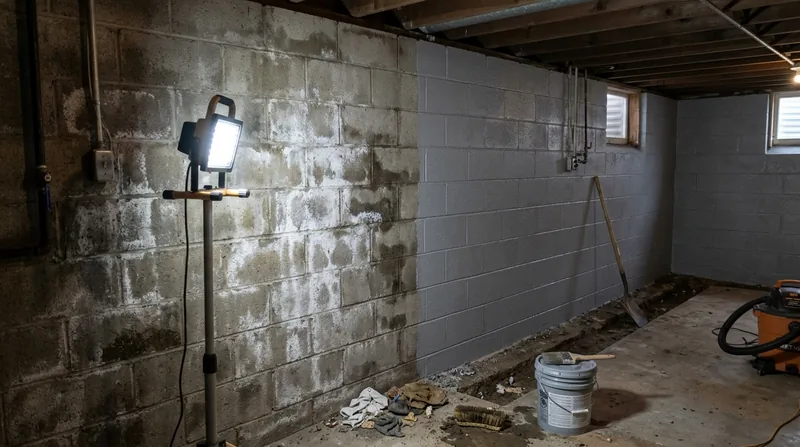




If you live in Great Neck, Thalia, or Bayside, you already know the ground here holds water. Basement Wall Sealing in Virginia Beach starts with one honest question: is your wall damp from humid air and minor seepage, or is Tidewater's high water table pushing against it? Most of the city's 1950s brick ranches sit on slab or low block stem walls, and the 1970s to 1990s colonials in Kempsville and Windsor Woods sit on raised block foundations, so we see far more stem-wall seepage, slab-edge dampness, and efflorescence than full below-grade basements. We prep the surface, remove the bloom, and apply the right penetrating or membrane sealer for the problem you actually have, and we tell you when a sealer is not the answer. If you are still sorting out the bigger picture, start with our basement waterproofing overview before you spend a dollar on coatings.
Why Wall Sealing Matters on Virginia Beach's Flat, Wet Ground
The city sits on flat sand, silt, and clay with the water table often only a few feet down. Nor'easters, tropical storms, and tidal creeks push water against foundations, and the block stem walls common in Lynnhaven and Chic's Beach wick that moisture upward. A sealer on a damp wall slows vapor drive and stops surface dusting, but it cannot hold back standing hydrostatic pressure, and pretending otherwise is how homeowners waste money.
- Efflorescence and white salt bloom tell you water is moving through the block, not just condensing on it.
- Damp patches that grow after rain point to a crack or a failed parging coat, not to the paint.
- Bubbling paint or a musty basement smell usually means moisture is trapped behind a non-breathable coating.
- A wet slab edge in a slab-on-grade ranch often traces back to grading and downspout extension, not the wall itself.
We test for moisture before we recommend a product, because sealing a wet wall from the inside without fixing the source traps water in the block.
Key info: In Pungo and Blackwater farmhouses on larger lots, we often find the wall itself is sound and the real problem is a downspout dumping at the foundation and grading that slopes back toward the house. Sealing there is a finish step, not a fix.
For questions about what the city requires on structural or drainage work, start with the City of Virginia Beach building department, since local thresholds vary and must be verified.
How We Seal a Basement Wall in Virginia Beach, Step by Step
We do not roll sealer onto a dirty, damp wall and call it done. Every job starts with a moisture reading and a walk of the exterior grade, then we prep the surface and choose a penetrating sealer for porous block or a flexible membrane for hairline cracking. If we find an active crack, we stop and talk about injection before any coating goes on.
- We inspect the wall, the slab edge, and the exterior grade, and we take moisture readings at several heights.
- We remove efflorescence with a dry brush and a mild acid wash, then let the block dry to a stable reading.
- We grind or wire-brush loose parging and patch spalled mortar joints before any product goes on.
- We apply a penetrating sealer on porous block, or a flexible membrane where hairline movement is likely.
- We extend downspouts and correct the grade so water leaves the wall instead of sitting against it.
If the wall is actively weeping after every storm, the honest answer is usually an interior drain tile system, not another coat of sealer.
Key info: A 1960s block ranch off Shore Drive in Chic's Beach had white bloom halfway up the wall and paint peeling at the base. The sealer alone would have failed. We corrected the downspouts, sealed the block, and the wall has stayed dry through two nor'easters.
Sealing Approaches We Use and When Each One Fits
Not every wall wants the same product. Porous block drinks a penetrating sealer and stays breathable, while a poured or parged wall with hairline checking does better with a flexible membrane that bridges small movement. We match the approach to the wall, the moisture reading, and the water source.
| Approach | Description | Best for |
|---|---|---|
| Penetrating sealer | Soaks into block and reacts to form a breathable barrier against vapor drive. | Damp block stem walls with efflorescence and no standing water. |
| Flexible membrane | A rubberized coating that bridges hairline checking and small movement. | Poured or parged walls with surface cracks and minor seepage. |
| Crack injection first | Epoxy or polyurethane injection ports seal an active crack before any coating. | A defined crack that leaks after rain, sealed at the source. |
| Drainage correction | Downspout extension, regrading, and footing drain work to move water away. | Walls that only leak where runoff pools against the foundation. |
| Interior drain tile | Perimeter drain and sump basin relieve hydrostatic pressure at the footing. | Walls that weep under pressure no sealer can hold back. |
Basement Wall Sealing Cost in Virginia Beach: What to Expect
Most residential wall sealing jobs here start from $1,500, and that figure covers surface prep, efflorescence removal, and a quality sealer on a typical stem wall or garage-level utility room. The number moves with wall length and height, how much prep the block needs, whether we find active cracks that need injection first, and how much grading and downspout work is required. A waterfront cottage in Sandbridge with salt-damaged parging costs more to prep than a clean block wall in Kempsville.
Get two or three written estimates and compare scope, not just the bottom line. A low bid that skips prep and moisture testing is a coating that will peel within a season. Our full pricing overview lays out the ranges so you can compare apples to apples.
Hiring a Waterproofing Contractor Near Virginia Beach: What to Check
Confirm the company carries general liability and workers' compensation, and call a couple of references from jobs like yours, ideally a block stem wall and not just a full basement. Get the scope in writing, including prep steps and product names, and ask who pulls any permit if the work touches structural repair or drainage tied to the sanitary connection. If you are in an HOA, check the rules on exterior grading and discharge location before work starts.
You can reach us through our contact page to schedule a free inspection and get a written scope.
Basement Wall Sealing Near Me: What Virginia Beach Homeowners Should Know
When you search for basement wall sealing near me, you will find plenty of outfits that roll on a coat and leave. The right contractor reads the wall first: moisture meter, exterior grade, downspout discharge, and a look at the footing drain if one exists. If the water is coming through a crack, we inject it. If it is hydrostatic pressure, we say so and quote drainage, not a sealer. That honesty is the whole job.
Basement Wall Sealing in Virginia Beach: Pricing Guide
| Service | Price | Details |
|---|---|---|
| Stem wall sealing | Starting at $1,500 | Surface prep, efflorescence removal, and penetrating sealer on a typical block stem wall. |
| Membrane coating | Starting at $1,900 | Flexible membrane on a parged or poured wall, priced by wall length and prep. |
| Crack injection plus sealing | Starting at $2,400 | Epoxy or polyurethane injection on active cracks before any sealer is applied. |
| Complex or large-scale job | On estimate | Long walls, heavy efflorescence, or grading work need an on-site look first. |
| Travel | Included | in Virginia Beach and surrounding areas, with no separate call-out or mileage fee. |
| Estimate | Free | Response within 24h at (757) 217-1799, with no obligation to book. |
Indicative pricing, the exact cost depends on square footage, finish, and site access. Free personalized estimate within 24h at (757) 217-1799.


